Environmental Management
Basic Concept
In order to contribute to the development of a sustainable society, the Tsubaki Group has established the Basic Environmental Policy and is working to reduce its environmental impact from a medium- to long-term perspective while proactively developing and offering products with high environmental value. In particular, we will address the issue of climate change, which we view as a priority issue of the utmost urgency, by closely monitoring international standards and market and customer trends.
Basic Environmental Policy
The Tsubaki Group recognizes that protecting the global environment is one of the most critical shared issues facing humanity. Through our global business activities, we strive to incorporate environmental considerations throughout our entire supply chain, and through manufacturing, create both environmental and economic value, thereby contributing to the development of a sustainable society.
1. Protection of the Global Environment
We will strictly comply with applicable laws and agreements in each region, continuously improve our environmental management system, and sincerely engage in efforts to protect the global environment.
2. Addressing Climate Change
To realize a decarbonized society, we will take action on climate change through measures such as reducing greenhouse gas emissions and actively adopting renewable energy.
3. Building a Circular Society
We will contribute to the realization of a circular society by promoting the efficient use of resources such as energy and water, as well as the 3Rs (Reduce, Reuse, Recycle). We will also strive to prevent pollution through the proper management of plastics, waste, and hazardous chemicals.
4. Harmony with Nature and Biodiversity Conservation
In the regions where we operate, we will strive to coexist with nature as a good corporate citizen, taking into account the Kunming-Montreal Global Biodiversity Framework.
5. Creation of Sustainable Products
We will designate products that contribute to solving social issues as sustainable products (environmentally and socially responsible products) and reduce environmental impact through both new product development and marketing activities.
6. Promoting Environmental Communication
We will strengthen environmental education for Group employees and engagement with suppliers, while striving to appropriately disclose environmental information to stakeholders and promote greater social trust.
End
Established April 1, 2000
Revised April 1, 2026
Tsubakimoto Chain Co.
Environmental Medium- to Long-Term Targets and Activity Policy
Environmental Medium- to Long-Term Targets
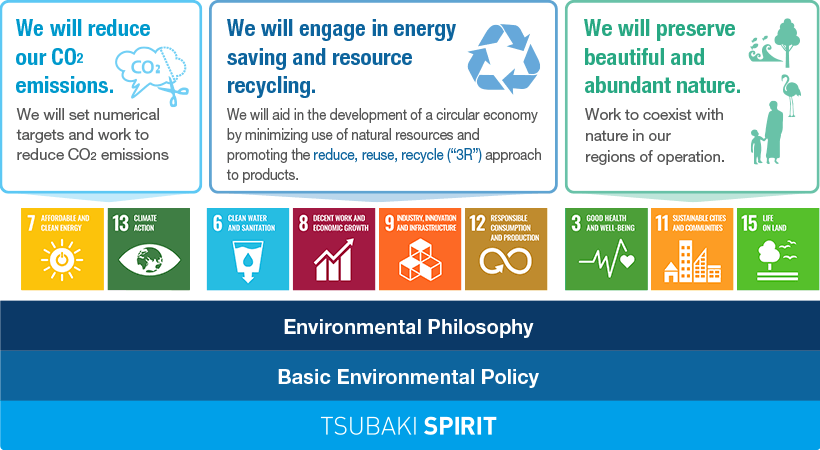
CO2 Emissions Reduction Targets
| Indicator | Scope | FY 2030 Target (Medium-Term Target) | FY 2050 Target |
|---|---|---|---|
| Scope 1 + 2 Emissions reduction rate |
Global | 42% (compared to FY 2021) |
Carbon neutrality |
| Scope 3 Emissions reduction rate |
25% in Category 1 and 11 (compared to FY 2021) |
||
| Ratio of renewable energy consumption |
Domestic | Set during FY 2026 | 100% of power consumption |
Activity Policy for Achieving Goals
Reducing CO2 emissions and promoting resource recycling
1. Energy saving, resource conservation, productivity improvement, introduction of high-efficiency equipment, and introduction and utilization of renewable energy in plant operation
2. Promotion of the EcoFactory Certification System (reducing CO2 emissions, reducing hazardous substances, recycling of waste, efficient use of water, and improving greening rate)
Reducing life cycle CO2 emissions and realizing a circular economy throughout the supply chain
1. Promotion of green purchasing (weight reduction, compactness, use of new materials, and promotion of the Three R’s)
2. Promotion and expansion of sales of company products and new products with high environmental value
3. In logistics, reduction of CO2 emissions and efficient use of resources
Promoting environmental initiatives in local communities
1. Active participation in local environmental activities
2. Coexistence with the local community through the opening of greenery areas, etc.
More information about each activity is provided on the following pages.
Reducing CO2 emissions and promoting resource recycling:
Response to Climate Change Initiatives for a Recycling Oriented Society and Pollution Prevention Environmental Performance Data
Activities through the:
Supply Chain Management (Business Partners)
Environmental activities in local communities:
Coexistence with Nature and Conserving Biodiversity Coexisting with Local Communities
Management System
The Tsubaki Group Environmental Committee takes the lead in promoting activities to address environmental issues, including climate change, under the supervision of the Sustainability Committee, which is chaired by the COO.
Under the Tsubaki Group Basic Environmental Policy, the Tsubaki Group Environmental Committee, which is chaired by the executive officer in charge of the environment and comprises general managers of business segments and representatives of Group companies in Japan, addresses the Group’s environmental issues, including climate change, from a medium- to long-term perspective. Furthermore, we assign environmental managers to domestic business sites, and we have established the Environmental Managers Committee as a body for implementing environmental activities. Environmental managers are also assigned to overseas business sites and collaborate with the Sustainability Strategy Department (Group Environmental Secretariat).
System for Promoting the Environment
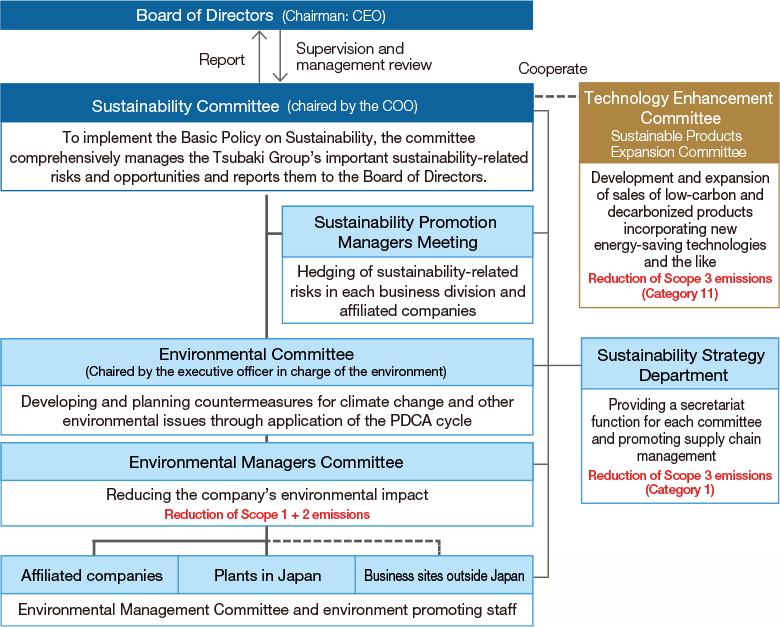
Scope 1: Direct emissions of greenhouse gases by the business operator itself (fuel combustion, production processes)
Scope 2: Indirect emissions associated with the use of electricity, heat, and steam supplied by other companies
Scope 3: Indirect emissions other than Scope 1 and Scope 2 (emissions of other companies related to the activities of the business operator)
Implementation of the Tsubaki Group Global Environmental Management Manual
Since FY 2023, we have been implementing the Tsubaki Group Global Environmental Management Manual. Based on this manual, each business site undertakes environmental activities unique to the Tsubaki Group. Various environmental data and the status of compliance with environmental laws and regulations are regularly reported to the Sustainability Strategy Department, and this results in improvements to environmental activities throughout the Group, along with the timely disclosure of information.
Environmental Management Systems at Each of Our Business Sites
At our domestic and overseas manufacturing sites, we are implementing environmental protection PDCA in accordance with the EMS (ISO 14001) for each of our sites, and are promoting the Tsubaki Group’s unique environmental improvement activities.
The environmental management system at each business site includes setting environmental policies and targets, evaluating compliance with environmental laws and regulations, identifying risks and opportunities through environmental impact assessments and taking initiatives, conducting internal audits and management reviews, responding to emergencies, and managing communications with stakeholders.
ISO 14001-Certified Business Sites
In 2001, the Tsubaki Group’s Saitama Plant and Hyogo Plant acquired ISO 14001 certification, and all domestic business sites (including those of our Group companies) have since acquired the same certification. Overseas, a total of 20 major subsidiaries and plants have been certified.
List of Tsubaki Group business sites with ISO 14001 registration (331 kB)